Recently Introduced Reforms Under CGST Laws

Reforms Under CGST Laws

Consistant towards achieving a solid GST structure and preventing cases of GST leakages and frauds government keeps on improvising the tax laws for good. Many new provisions are allowed by the government and some old ones are amended in order to make GST a much more convenient and realistic form of tax governance.

With effect from 09-10-2019, one of the major GST amendments introduced in CGST laws with respect to input tax credits allows only 20% of the eligible credit returns for companies with irrelevant or incomplete invoice detailings.

It’s also mentioned in the laws that if the registered supplier is going through the period of suspension (suspension of GST registration) he is not eligible to release the GST invoice that means he will not charge tax on supplies made by him.

Let’s have a look on other equally relevant reforms brought in provisions currently under CGST Laws:

1. In Rule-21A(3), explanation inserted, states:-

“Explanation.-For the purposes of this sub-rule, the expression “shall not make any taxable supply” shall mean that the registered person shall not issue a tax invoice and, accordingly, not charge tax on supplies made by him during the period of suspension.”;2. In Rule-21A, explanation inserted, states:-

“Rule-21A(5) -Where any order having the effect of revocation of suspension of registration has been passed, the provisions of clause (a) of sub-section (3) of section 31 and section 40 in respect of the supplies made during the period of suspension and the procedure specified therein shall apply.”

3. In Rule-36, explanation inserted, states:-

“Rule-36(4)- Input tax credit to be availed by a registered person in respect of invoices or debit notes, the details of which have not been uploaded by the suppliers under sub-section (1) of section 37,shall not exceed 20 per cent. of the eligible credit available in respect of invoices or debit notes the details of which have been uploaded by the suppliers under sub-section (1) of section 37.”.

4. In Rule 61(5), explanation inserted, states, with effect from 1st July,2017:-

“Rule-61(5)- Where the time limit for furnishing of details in form GSTR-1 under section 37 or in form GSTR-2 under section 38 has been extended, the return specified in sub-section (1) of section 39 shall, in such manner and subject to such conditions as the Commissioner may, by notification, specify, be furnished in form GSTR-3B electronically through the common portal, either directly or through a Facilitation Centre notified by the Commissioner. Provided that where a return in form GSTR-3B is required to be furnished by a person referred to in sub-rule (1) then such person shall not be required to furnish the return in form GSTR-3.”;

5. Rule 61(6) shall be omitted , with effect from 1st July, 2017, explanation inserted, states.

6. In Rule-83A(6), for clause (i), explanation inserted, states:-

“Rule-83A(6)(i) – Every person referred to in clause (b) of sub-rule (1) of rule 83 and who is enrolled as a goods and services tax practitioner under sub-rule (2) of the said rule is required to pass the examination within the period as specified in the second proviso of sub-rule (3) of the said rule.”.

7. In Rule-91(3), with effect from 24th September,2019, with “application for refund”, and “on the basis of a consolidated payment advice:” explanation inserted, states;

8. In Rule-91, following Sub-Rule with effect from 24th September, 2019, explanation inserted, states:-

“Rule-91(4) -The Central Government shall disburse the refund based on the consolidated payment advice issued under sub-rule (3).”.

9. In Rule-97 following Sub-Rule, with effect from 1st July, 2017, explanation inserted, states-

“Rule-97(7A) – The Committee shall make available to the Board 50 percent. of the amount credited to the Fund each year, for publicity or consumer awareness on Goods and Services Tax, provided the availability of funds for consumer welfare activities of the Department of Consumer Affairs is not less than twenty-five crore rupees per annum.”;

10. In Rule-97(8), clause (e) shall be omitted, with effect from 1st July, 2017, explanation inserted, states.

11. In Rule-117(1A) – for the figures, letters and word “31st March,2019”, the figures, letters and word “31st December,2019” explanation inserted, states.

12. In Rule-117(4), in clause (b),in sub-clause (iii), In the proviso for the figures, including “30thApril,2019”, the figures, letters and word “31st  January,2020”, explanation inserted, states.

13. In Rule- 142 following  Sub-Rule, – explanation inserted, states:-

“Rule-142(1A)- The proper officer shall, before service of notice to the person chargeable with tax, interest and penalty, under sub-section (1) of Section 73 or sub-section (1) of Section 74, as the case may be, shall communicate the details of any tax, interest and penalty as ascertained by the said officer, in Part A of form GST DRC-01A.”

14. In Rule-142(2), after the words “in accordance with the provisions of the Act”, the words, figures and brackets “, whether on his own ascertainment or, as communicated by the proper officer under sub-rule (1A),” explanation inserted, states;

15. In Rule -142 following Sub-rule explanation inserted, states:-

“Rule-142(2A) – Where the person referred to in sub-rule (1A) has made partial payment of the amount communicated to him or desires to file any submissions against the proposed liability, he may make such submission in Part B of form GST DRC-01A.”

Original Notification for New CGST Rules by CBIC

WEF’s India Economic Summit to Focus on Startups & Cut Down IT Rates

WEF India Economic Summit 2019

Measure to combat the gloomy phase of Indian economy was discussed in the World Economic Forum’s annual India Economic Summit. As per the discussion held in the event, abbreviating just the corporate taxes will not serve the purpose.

The growth rate of the Indian economy has declined to 5% in the April-June quarter, which is the lowest in the last six years. Other latest data such as GST collection & core sector output has also been negative which is a clear call for instant measures by the government.

The total GST collection of Rs 91,916 in September is the least figure among that of the last 19 months whereas the core sector output depicted the highest downturn of last more than 4 years in August with a decline by 0.5%.

The participants of the event, started in Delhi on Thursday with the joint effort of WEF and Confederation of Indian Industry, do not perceive that lowering down the corporate taxes will be able to restore the economy. They instead suggest for taking more measures & incentives such as cut down in income tax to invigorate the demand.

“Reduction in the corporate tax rate would be good but personal tax rate should also be cut down as the slowdown in demand is now clearly visible,” Adi Godrej, chairman of Godrej Group stated. “Government should provide more stimulus even if it means increasing the fiscal deficit,” he added.

Government proposals to revive the Indian economy from a six-year low of 5% in the April-June quarter includes blunt cut down in the corporate tax rate from 30% to 22%. The new tax rate at 15% for startups in the manufacturing sectors is also a part of the measures recommended.
Although the drop off in taxes will lead to revenue loss for the government but it will certainly be a financial booster of Rs 1.45 lakh crore to the Indian economy.

Experts from industries are pressing pedals for more reformation and incentives, as according to them, alterations in taxes are not enough to enliven the Indian economy & consumers from a depressing phase.
Gautam Kumra, managing partner at McKinsey also laid stress on different measures reformations to bolster the efficiency and competitiveness of India. He said, “Taxation is an important piece that will help India become competitive, but there are other aspects too including land, labour and financial sector reforms,”.

Read Also: All About Proposal Made for Income Tax Slabs & Rates by Task Force

Reformation for the startups was also underlined by some participants in the event. According to them, the government should focus on the startup ecosystem and adapt a mechanism which will help them access the capital requirement easily.

“Becoming a $5 trillion economy would not be possible without innovation,” statement made by Vani Kola, founder of early-stage venture capital Kalaari Capital. “Hence, there is a need for structural reforms for startups to access capital,” she added.

Measures from the Reserve Bank of India are also anticipated to be announced soon. RBI may further slash the policy rates while reviewing its monetary policy.

Uday Bansali, president (financial advisory) at Deloitte said, “The mood is optimism with caution and there is more need for transformation,”. He also said,. “I feel we will be doing well in the long run, but there are some hurdles in the short run that needs to be addressed.”

Borge Brende, a member of WEF’s managing board has an optimistic attitude towards the fast revival of Indian economy.

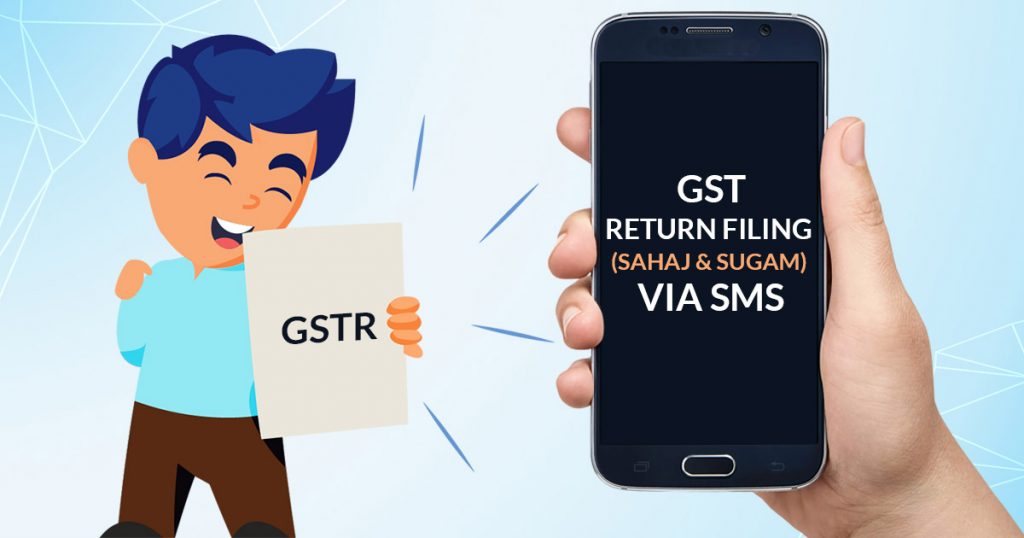
Govt to Initiate GST Return Filing (Sahaj & Sugam) via SMS

GST Return Filing Sahaj & Sugam Via SMS

The provision announced by the Central Government is a big relief to Small Traders. Commencing from 1 April 2020, the provision gives taxpayers the facility of filing GST just by sending an SMS from their registered number. The only disclaimer is that their turnover must be suspended. Not only this, small traders are obliged to file their returns once every three months via SAHAJ and SUGAM forms.

GST Network CEO Prakash Kumar told to the sources that taxpayers with suspended turnover are filing GST just because they have a GST number that they are obliged to file the returns, they are filing the returns. There is segregation for such taxpayers under the new GST system which will now ensure that such taxpayers are allowed to submit their returns only by sending SMS from their registered mobile numbers.

Returns can Now be File via SMS

As per the reports, commanded by the new system locked turnover assessee will have to send an SMS in return an OTP will be communicated to the taxpayer on his/her registered mobile number. On entering the relevant OTP their returns will be considered as filed.

The Technique will be in progress from 1st April 2020.

RET-02 – SAHAJ FORM

Taxpayers with the annual gross income of up to Rs. 5 Crore were earlier obliged to file GSTR 3B form but now two new forms are assigned for such assessees. The GST RET-2 Form is designated for those doing B2C business of up to Rs. 5 Crores per year.

RET-03 – SUGAM FORM

The law is convenient for businessmen as they will pay the tax every month but have to file the returns once in three months. Similar to that GST RET 3 or SUGAM form is obligatory for those whose annual turnover is up to Rs 5 Crore or who deal in bulk products or involved in B2B businesses. The form is filed on a quarterly basis, but tax payment will be on a monthly basis.

Changes in Rules from October 1: Check Impacts On Lives & Pockets

Various changes in different sectors including banking, driving license and GST from 1 October 2019 i.e. from today are going to significantly affect our lifestyles and budgets. According to the Reserve Bank guidelines, the banks will offer retail loans at repo rate linked interest rate, from today. At the same time, due to the revision in GST rates, the prices of various commodities will also be changed. In addition to this, some very important changes related to driving license have also come into effect from today.

Let us Know these Changes in Detail:

  • Repo rate linked the interest rate
  • Following the RBI guidelines, various public sector banks including SBI, Canara Bank and Corporation Bank have presented retail loans at repo rate based interest rates from October 1. This will cut down your monthly EMI due to a reduction in the repo rate by RBI.
  • Earlier, banks did not give full benefit of the reduction in the repo rate to the customers instantly and this is the reason that the central bank issued guidelines on September 4, directing retail and MSME loans to be linked to external benchmarks.

SBI will Impose a Lesser Penalty for Not Maintaining a Minimum Balance

SBI, the nation’s largest bank, has announced a drastic reduction in the amount of penalty charged for not maintaining the minimum balance. This decision becomes effective from today. Apart from this, SBI customers from Metro and non-metro cities will be allowed to pay 10 and 12 transactions, respectively, for no charge.

Changes in the GST Rate Will cause Changes in the Prices of Goods

As per the decisions of the GST Council, the new GST rates have come into effect from October 1. Now the hotel rooms with rent up to Rs 1,000 are GST exempt. However, the new GST rate of 12 percent is applicable to rooms with a rent of Rs 7,500.
At the same time, the new GST rate of 12% is applicable to train coaches and wagons. In addition, caffeine drinks will also become expensive because of the leviability of 28% GST along with additional cess of 12% on such substances.

Huge Reduction in Corporate Tax

The government recently announced a drastic reduction in corporate tax which will give huge relief to domestic companies. Finance Minister Nirmala Sitharaman had declared the reduction of corporate tax from 30 percent to 22 percent. This reduction becomes effective from today. Also, manufacturing companies formed after October 1 will now have to pay corporate tax at the rate of only 15%.

Rules Related to Driving license and RC Have Changed

Many changes in the rules related to driving license have become effective from October 1. Under the changes, you will have to update your old driving license which can be done online. Along with the implementation of this rule, the color of driving license and RC will be the same across the country.

Discard of Cashback on Payment by Credit Card at Petrol Pumps

Cashback of 0.75 percent on payment by credit card at petrol pumps after filling petrol or diesel, will no longer be available. Banks offering credit cards have informed their customers through the message that the public sector petrol companies have decided to abolish this exemption from October 1. However, this exemption on payments by other means will sustain.

Different GST Testing Procedures Under Internal Audit

GST Testing Procedures Under Internal Audit
  • Verify the invoice reveals details of all the particulars mandatory as per the GST Act (Invoice number and date, Customer name, Shipping and billing address, Customer and taxpayer’s GSTIN (if registered), Place of supply, HSN code/ SAC code, Item details i.e. description, quantity (number), unit (meter, kg etc.), total value, taxable value and discounts, Rate and amount of taxes i.e. CGST/ SGST/ IGST, Whether GST is payable on reverse charge basis, signature of the supplier) on a sample Basis.
  • Verify that a Self-invoice is generated for all the RCM payments revealing the details according to the Act (The Self-invoice should also unveil all the necessities of a forward charge invoice as described in the above point).
  • The entity should perform testing procedure-GSTR 3B vs GSTR 1 vs Books reconciliation for output tax (It should be ensured during GST testing under internal audit that the mentioned testing procedure being performed by the entity or not and being re performed repeatedly for accuracy and validity).
  • It should be verified that the entity is performing testing procedure-GSTR 3B vs GSTR 2A vs Books for reconciliation of input credit claimed and input details uploaded by the supplier in his GSTR-1, periodically or not.
  • The filling of all the GST returns within the due dates should also be verified
  • The verification of claimed input credit by the company is eligible credit or not should be done. Since the entity is not eligible to claim blocked credit as per sec 17(5).
  • It should be verified that the payments are made to suppliers within 180 days from the date of invoice for which input credit is claimed. Otherwise, the input should be reversed if the payment is not made within 180 days.
  • The E-way bill system of the entity should also be reviewed in order to find out whether the details of the e-way bill issued from business whenever necessary, match with the details of sales or purchase invoices, whichever is the case, etc).
  • It is to be ensured that the company is maintaining HSN/SAC wise details for Output, Inputs (needed for filing annual return (GSTR-9)).

The statutory audit season were about to end with the end of September month though it has extended for one more month due to the extension of due dates. Post expiry of audit season, the companies start focusing on internal audits. In internal audits statutory compliance remains a compulsory component which consists of basic reconciliations as part of GST testing. Other than this, several other testing procedures can also be included as a part of GST testing which are listed below:

  • Verification of a certificate of registration whether it is prominently displayed to all the locations where business is done or not.
  • Verification of GSTIN no. whether it is included with the name of the business in displays (Rule 18 under CGST Rules mandates showcase of Goods and Services Tax Identification Number of every registered person on the name board displayed at the entry of principal place of business and at other places or places of business.)

Read Also: GST Audit Types – Statutory, Departmental, Special & Management Audit

  • Verify that the organisation with different branches in different states gets different registration and the other places of business within the states gets updated in the registration certificate.
  • Verify the GST registration data of customer master is valid or not. It can easily be done with the use of online tools available for free at (verifies validity of 50 GSTINs at once)- https://app.sahigst.com/search-taxpayer .

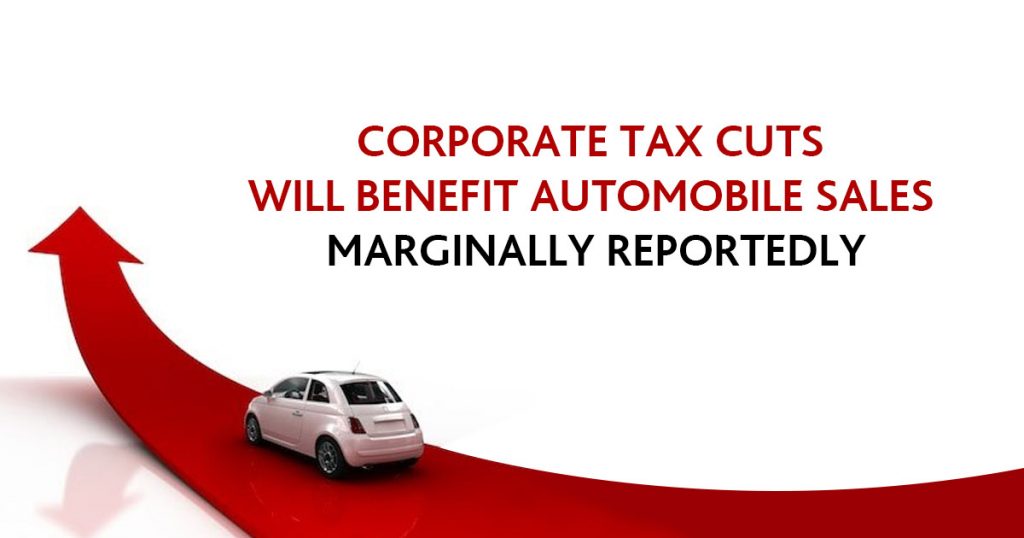
Corporate Tax Cuts will Benefit Automobile Sales Marginally Reportedly

Corporate Tax Cuts will Benefit Automobile

According to a report, auto sales which were witnessing a steep fall will only be benefited with a minimal discount of 1-2 per cent discount only as against to proposed massive reduction in corporate tax which brings down the levy on companies to 10-12 percentage points. In contrast to this, if the government offered a GST reduction, the automobiles demand to see a rise which helps the automakers in offering a discount of 7-8 per cent, the report further added. In the last two decades, the auto industry is witnessing the worst crisis and urging for a GST slash from prevailing 28 per cent to 18 per cent which supports the industry in raising dwindle sales.

However, the GST Council completely ignored the pledge of the auto industry as the Central government come up with the decision of reducing corporate tax rates to benefit entire India. It is for the first time the country is following the deepening slowdown within the last 45 years and the first quarter GDP is reflecting the same with a six-year low of 5 per cent. According to the reports, the states will bear around 50 per cent of the Rs 1.45 lakh crore tax giveaways, which will put their finances into a deep-freeze. Ahead of the GST council meet in Goa on September 20, finance minister Nirmala Sitharaman announced for GST tax rate cuts.

“Original equipment makers (OEMs) could choose to pass corporate tax cut benefits to customers, but this would imply only a 1-2 per cent additional discount as against 7-8 per cent if they were offered a 10 per cent GST cut (which did not happen),” foreign brokerage Jefferies quoted in a report. It is to be noted that the reduction in GST by a 10 per cent point would have brought on-road prices of the vehicle down by around 7-8 per cent, as per the report,” as a result, the issue of inventory pile-up ahead of the BS-VI transition in April persists, particularly for two-wheelers and medium and heavy vehicles.”

Considering a sharp surge in demand during the upcoming festive season, Maharashtra and Kerala region, among others observed a relatively weak demand in the first phase of the festive season, as suggested from the reports.

Consequently, OEMs will have to announce a heavy cut in pricing to bring inventory under control and to earn a share of the second half, the report suggests. The auto companies are already offering heavy discounts to overcome the crisis. If considered M&M’s Pawan Goenka records, a 20 per cent discount was already on offer which had been increased near about 30 per cent in Q1, the worst in two decades.

Read Also: How Corporate Tax Cuts Influenced the Indian Economy?

According to the report, the marginal tax rate cut from 34.9 per cent to 25.2 per cent would increase in earning per share about a 5-13 per cent for the OEMs. In other words, the tax cuts will boost OEMs earnings of around 5-13 per cent in the bottom line. However, the benefit would start witnessing from Q2, or even the write-back on higher taxes of Q1 and deferred tax liability showcased in Q2 number, it added. “We do not expect a significant turnaround in demand immediately and BS-IV inventory correction remains a headwind for 2HFY20. However, the measures have improved the prospects for a quicker and stronger recovery next fiscal,” the report concludes.

CAIT Notifies FM About GST Defraud of E-Commerce Companies During Festival Sale

CAIT Notifies GST Defraud E-Commerce

According to an allegation of the merchant organisation Confederation of All India Traders (CAIT), the e-commerce companies are cheating GST through their festive season sale. The CAIT informed Finance Minister Nirmala Sitharaman via a letter that many e-commerce companies like Amazon and Flipkart are collecting reduced GST during their festive season sales which will cause in the reduction of their government’s GST revenue collection.

The CAIT further stated in the memorandum that the e-commerce companies which have started their “Festival Sale” especially Amazon and Flipkart are violating the Government’s Foreign Direct Investment (FDI) policy. The CAIT has a complaint from the government when a businessman is caught with a slight mistake during the business then a strict action is taken and now these e-commerce companies which are authorized only for Business to Business (B2B) transactions and performing Business to Consumers (B2C) transactions directly and not being considered for a legal action till now.

CAIT General Secretary Praveen Khandelwal through a letter tried to notify Finance Minister that these e-commerce companies are selling goods which are high in demand during their “Festival Season” and providing a huge discount ranging from 10 percent to 80 percent on the market value and the GST being levied on the same amount. Consequently, the GST revenue collection of the Government will have to face a huge loss. For which, the CAIT urged to the Finance Minister to look into the matter and investigate the business model of these e-commerce companies.

List of Goods and Services Not Eligible for Input Tax Credit

Goods and Services Not Eligible for ITC

Input tax credit is considered very significant for every business unit which is always in the need to invest in the business in the manner of capital. The need of capital is required each and every time a business gets ready for its next project. This time in GST, a business unit will be eligible for input tax credit, only if certain cases are met with the transactions.

Recommended: All Decisions & Latest Updates on 32nd GST Council Meeting

Invoice matching of both the parties will be the key issue for checking and granting the input tax credit to the dealer while in certain cases, input tax credit may not be available for some rules and regulation purpose.

Some of the Goods and Service which are not Eligible for Input Tax Credit

Read Also: Input Tax Credit Guide Under GST: Calculation with Proper Examples

S.No.ItemsExceptions
1Motor VehiclesExcept in casesExtended supply of such vehicles or conveyances;Transportation of passengers or
2Other ConveyancesProviding training on driving, navigating such vehicles orConveyances for transportation of goods;
3Foods, Outdoor Catering, Beauty Treatment, Health Services Cosmetic, Plastic SurgeryExcept where an inward supply of goods or services or both of a particular category is consumed by a registered person for making an outward taxable supply of the same category of goods or services or both or as an element of a taxable composite or mixed supply
4Membership of a Club,
5Membership of a Health Centre
6Membership of a Fitness Centre;
7Rent-a-cab, Life Insurance, Health InsuranceThe Government states the services which are mandatory for an employer to provide to its employees under any law for the time being in force; orSuch inward supply of goods or services or both of a particular category is used by a registered person for making an outward taxable supply of the same Category of goods or services or both or as part of a taxable composite or mixed supply.
8Travel benefits extended to employees on vacation such as leave
9Travel benefits on home travel concession
11Works contract services when supplied for construction of an immovable propertyExcept where it is an input service for extended supply of works contract service and plant and machinery
12Goods or services or both received by a taxable person for construction of an immovable propertyExcept goods or services received on his own account including when such goods or services or both are used in the course or furtherance of business and plant and machinery
13Goods or services or both on which tax has been paid under section 10;ie. Under section 10 composition scheme
14Goods or services or both received by a non-resident taxable personExcept on goods imported by him
15Goods or services or both used for personal consumption
16Goods lost
17Goods written off
18Goods destroyed
19Goods stolen
20Goods disposed of by way of gift or free
samples
21Any tax paid in accordance with the provisions of sections 74, 129 and 130.I.e. In

Due Dates of Filing ROC Annual Return for FY 2018-19

Every company is required to file the annual accounts and annual return as per The Companies Act, 2013 within 30 days and 60 days respectively from the conclusion of the Annual General Meeting. The ROC filing of annual accounts is governed under Section 129 (3), 137, of The Companies Act , 2013 read with Rule 12 of the Company (Accounts) Rules, 2014 and annual return is governed under Section 92 of the Companies Act, 2013 read with Rule 11 of the Companies (Management and Administration) Rules, 2014.

Recommended: Free Download MCA/ROC Return Filing Software

Due Dates of ROC Return Filing (FY 2018-19)

Name of E-formPurpose of E-formDue date of FilingDue Date for FY 2018-19
Form ADT-1Appointment of Auditor15 days from the conclusion of AGM15th October 2019
Form AOC-4 and Form AOC-4 CFS (in case of Consolidated financial statements)Filing of Annual Accounts30 days from the conclusion of the AGM (In case of OPC within 180 days from the close of the financial year)30th October 2019
Form MGT-7Filing of Annual Return60 days from the conclusion of AGM29th November 2019
Form CRA-4Filing of Cost Audit Report30 days from the receipt of Cost Audit Report30 days from the receipt of Cost Audit Report
Form MGT-14Filing of resolutions with MCA regarding Board Report and Annual Accounts30 days from the date of Board Meeting30 days from the date of Board Meeting
Form MSMEHalf yearly return with the registrar in respect of outstanding payments to Micro or Small Enterprise.Within a month for each half of the year31st October 2019 (April 2019 to September 2019)30th April 2020 ( for October 2019 to March 2020)

The Concept of Penalty/Additional Fees

NOTE: Additional Fees for E-form AOC-4 (XBRL and Non-XBRL) and E-form MGT-7 after the due date is RS. 100 per day with effect from 1st July 2018.

For other forms, docs etc.

Period of DelaysFees
Up to 30 days2 times of normal fees
More than 30 days and up to 60 days4 times of normal fees
More than 60 days and up to 90 days6 times of normal fees
More than 90 days and up to 180 days10 times of normal fees
More than 180 days and up to 270 days12 times of normal fees

Income Tax Return Filing Due Dates for FY 2018-19 (Last Date)

File Tax Returns for A.Y. 2019-20 before 31st March with INR 10,000 Penalty

The income tax department notified the taxpayers for late filing of tax returns for A.Y. 2019-20, along with a penalty of INR 5000 (on filing the return after the due date but on or before 31st December) and INR 10000 (on the filing of return after 31st December to 31st March). The taxpayer has to file the late filing of tax returns for A.Y. 2019-20 before 31st March anyhow. Also to note that the penalty is applicable even if the taxpayer files the returns before 31st March while there is no option to file the returns after 31st March 2020.

Last Date of Income Tax Return Filing for AY 2019-20

(Assessee who are required to furnish report under sec 92E)

  • Due date of filing the Income Tax Return by Assesse who are required to furnish report under sec 92E is 30th November 2019.

Advance Income Taxes Filing Due Dates FY 2018-19

If the tax liability is more than Rs 10,000 in a financial year then advance tax needs to be paid by the assessee.

15th June (15%) | 15th Sept. (45%) | 15th Dec. (75%) | 15th March (100%)

The assessee who are covered under section 44AD, are also required to pay the advance tax on or before the 15th march of the previous year.

  • A Company
  • A Person (Other Than a Company) whose accounts are required to be audited under this Act or under any other law for the time being in force, or
  • A working partner of a firm whose accounts are required to be audited under this Act or under any law for the time being in force

What is the Income Tax?

There are two types of tax levy one is direct tax second one is an indirect tax. Income tax is a direct tax which is directly attributable to the income of the assessee. Income which is generated from the various head of income viz.Salary, House Property, Business, Capital Gain and Income from other sources. The assessee has to pay Income tax if his total Income after allowing Chapter VI-A Deduction is more than the taxable income limit.

Filing Income Tax Return Due Dates for FY 2018-19 (AY 2019-20)

There is a different category of taxpayer viz. Individual, HUF, Firm, LLP, Company, Trust and AOP/BOI. Due Date is different according to audit or non-audit case of such categories as defined in section 139(1)

Last Date of Income Tax Return Filing for AY 2019-20 (Non-Audit Cases)

  • Due date of filing the Income Tax Return by Assesse whose Books of Account are not required to be audited is 31st July 2019. The income tax department has extended the due date till 31st August 2019Notification here

Filing Income Tax Return Due Date for AY 2019-20 (Audit Cases)

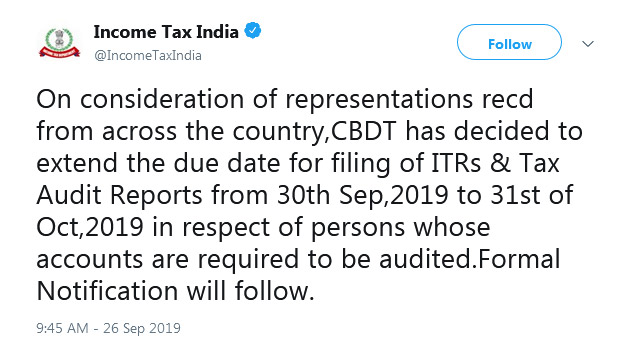
The due date for filing the Income Tax Return by Assesse is 30th September 2019.

Note: “On consideration of representations recd from across the country,CBDT has decided to extend the due date for filing of ITRs & Tax Audit Reports from 30th Sep, 2019 to 31st October 2019 in respect of persons whose accounts are required to be audited. Formal Notification will follow.” as Income tax department tweeted on 26th September.