Important Factors for UIN Entities While GST Refund Process

UIN-Entities GST Refund Process

The GST ACT allows foreign entities like Consulates, Embassies and other UN organizations who have made their roots in India to claim the GST which they paid. Such entities cannot be given a GSTIN number because they are not registered in India. Instead of it, they are given a UIN (Unique Identification Number) number and because of this, they are known as UIN entities.

This UIN number is only given to those entities who file invoice level data in the GSTR 11 form which is present in the government official GST portal. GST authorities noticed some common differences when they were processing the refund applications. So after knowing about these differences, they thought of reducing them due to which CBIC furnished notices regarding the GST Refunds in December 2018 and among them one was for the UIN entities.

UIN Entities – Things to Note While Processing GST Refunds

In GSTR 11 Form, for every invoice, the “Place of Supply” must be reported in the form which is applied for a refund according to the CGST rule. But many UIN entities were reporting the wrong place as “place of supply” i.e. their registered state while filing their invoice instead of original “place of supply”.

For example- if a place of supply is taken from Rajasthan but the place of supply is reported as Mumbai because the embassies are registered in Mumbai which is wrong. The place of supply must be Rajasthan.

Why This is Important?

It is important because, under the GST law, the charge of the invoice is done by the IGST or CGST / SGST as per the place of supply.

  • If the place of supply is intra-state, then CGST and SGST are charged.
  • If the place of supply is inter-state, then only IGST is charged.

So it is very important that the place of supply while reporting in GSTR 11 Form and the CGST / SGST or IGST charge-ability on the invoice must be entered as per the details are given in the invoice which was issued by the supplier of good or services. If it is done wrong, then the processing will take more time or even the GST refund claimed by the UIN entities can be rejected.

Ather Energy Offers Benefit to Customers of Reduced GST Rates on EV

Ather Energy Benefit to Customers

Not later than a few years, there will be a resonance of ‘Electric Vehicles‘ everywhere in Indian Markets. One of the electric vehicle manufacturers in India, Ather Energy conveys that it will give the entire benefits to its customers of reduced GST rates entirely supporting the government’s initiative to lower the Goods and Services Tax (GST) rate on electric vehicles to 5% from 12% earlier.

The reduction in GST rates will surely increase the demand for its electric vehicles in the market and to pick up with that, the company has already started stressing upon the manufacturing of the vehicles.

Read Also: GST Rates Applicable to Cars and Its Accessories

This considerable curb in the GST rates for electric vehicles will reduce the sticker price of its scooters by 8,000 to 10,000, eventually bringing down the rates of these electric vehicles closer to its oil-consuming equivalents. Ather Energy’s 450 scooter costs Rs. Rs 1,22,647 after Rs. 27,000 subsidy from the government. The company is gearing up with its production and is expecting everything to settle by the start of next year. For now, the company reaching out to the vendors where the range is less and even investing to increase production.

The company targets to produce 25,000 vehicles by the first quarter of the next FY from its own manufacturing units. They are even looking out for ways to compass outside their own units.

On a good note, the cost of Electric Scooters will come closer to its other counterparts because of the reduction in GST rates, which will involve many to buy electric scooters over petrol-driven vehicles.

Revised GST Slab Rates in India FY 2019-20 Finalized by the GST Council

Revised GST Slabs in India for FY 2019-20

RatesCommodity/Services
0%Milk, Butter Milk, Curd, Cereals, Natural Honey, Flour, Besan, Puffed rice, Papad, Bread, Prasad, Salt, Bindi. Sindoor, Contraceptives, Fresh Fruits and Vegetables, Firewood, Bangles (non-precious metals), Agricultural Implements, Stamps, Judicial Papers, Printed Books, Newspapers, Bangles, Human Blood, Guar meal, Hop cone (other than grounded, powdered or in pellet form), Certain dried vegetables such as sweet potatoes, maniac, Unworked coconut shell, Khandsari sugar, de-oiled rice bran, hearing aid accessories, Fortified milk, Sanitary pads, Raw material used in brooms, Commemorative coins circulated by the RBI or government, Saal leaves, Deities made of stone, marbles or wood, Vegetables in the state of uncooked or cooked by steaming or boiling in water while being frozen, branded and are in a unit container, Vegetable briefly preserved under the mixtures of sulfur dioxide gas, in brine, in sulfur water or in other preservative solutions but unsuitable in that state for immediate consumption, etc.
5%Namkeen/Bhujiya, Coffee, Tea, Kerosene, Coal, Cream, Skimmed Milk Powder, Branded Paneer, Frozen Vegetables, Processed Spices, Pizza Bread, Rusk, Sabudana, Medicines, Stent, Lifeboats, Soyabean, Groundnut, Sunflower Seeds, Vegetable Fats & Oils, Beet Sugar, Cane Sugar, Cocoa Beans, Shells, Paste, Tar, Peat, Lignite, Lpg For Domestic Consumption By Ioc, Hpcl, Bpcl, Nuclear Fuel, Nuclear Grade Sodium, Bakery Mixes, Doughs, Pizza Bread, Vermicelli, All Ores And Concentrates, Heavy Water and Other Nuclear Fuels, Compressed Air, Animal or Human Blood Vaccines, Iron/ Steel/ Ferrous Alloy – Kerosene Burners and Stoves, Iron/ Steel/ Ferrous Alloy – Table or Kitchen or Other Household Articles, Table or Kitchen or Other Household Articles of Copper, Copper Utensils, Solar Water Heater, Diagnostic Kits for Detection of All Types of Hepatitis, Newsprint, Handmade Safety Matches, Geometry Boxes, Hand Pumps, Renewable Energy Devices, Boats, Fishing Vehicles, Coronary Stents, Artificial Kidneys, Broomsticks, Jhadoo, Steel Utensils, Curtains, Toilet Linen, Blankets and Travelling Rugs, Bed Linen, Kitchen Linen, Terry Toweling, Terry Fabrics, Napkins, Mosquito Nets, Sacks and Bags, Man-made Apparel, Life Jackets (Highlighted Goods Under INR 1000), Job work on textile, Footwear under INR 1000, Cotton and Natural Fibres, Khadi Yarn, Match Boxes, Packed Organic Fertilizer, Fertilizers, Lobhan, Mishri, Batasha, Bura, Insulin, Agarbattis, Cashew Nuts, Mango Sliced Dry, Khakra & Plain chapati/roti, Food preparations for Weaker Sections, Ayurvedic/Unani/Siddha/Homeopathy medicines(Unbranded),  Plastic Waste/Parings/ Scrap, Rubber Waste/Parings/ Scrap, Hard Rubber Waste or Scrap, Paper waste or scrap, puffed rice chikki, peanut chikki, sesame chikki, revdi, tilrevdi, khaza, kazuali, groundnut sweets gatta, kuliya, Flour of potatoes put up in unit container bearing a brand name, Chutney powder, Fly ash, Sulphur recovered in refining of crude, Fly ash aggregate with 90% or more fly ash content, Desiccated coconut, Narrow woven fabric including cotton newar [with no refund of unutilised input tax credit], Idli, dosa batter, Coir cordage and ropes, jute twine, coir products, Worn clothing, mehendi paste in cones, velvet fabric, tamarind kernel powder, articles of straw, Fertiliser grade phosphoric acid, Handloom dari, imported urea, E-books, Parts and accessories for the carriages for the disabled person, Marble rubble, Natural Cork, Walking Stick, Fly ash Blocks, Renewable energy devices & parts for their manufacture (biogas plant/solar power based devices, solar power generating system (SGPS) etc) [falling under chapter 84, 85 or 94 of the Tariff] or other equipment being used in such plants attracting GST, Construction services applicable to the solar power plants, For the clarification of all the cases having 70% of the gross value shall be deemed as the value of supply of the particular goods having 5% GST rate and the remaining portion (30%) of the aggregate value of such EPC contract shall be deemed as the value of supply of taxable service having standard GST rate, etc.
12%Dry Fruits In Packaged Form, Ayurvedic Medicines (Branded), Butter, Cheese, Ghee, Fruits And Vegetable Juices, Tooth Powder, Coloring Books, Picture Books, feature phones, Umbrella, Sewing Machine, Milk Beverages, Bio-Gas, Medicinal Grade Hydrogen Peroxide, Anaesthetics, Potassium Iodate, Iodine, Steam, Glands And Other Organs For Organo-Therapeutic Uses, Ayurvaedic, Unani, Homoeopathic Siddha Or Biochemic Systems Medicaments, Sterile Suture Materials, Sterile Catgut, Sterile Suture Material, Sterile Dental Yarns, Sterile Tissue Adhesives For Surgical Wound Closure, Dental Haemostatics, Fountain Pen Ink, Ball Pen Ink, Candles, Silicon Wafers, Natural Cork Wood Pulp, Children’S Drawing Books, Calendars, Ceramic Tableware, Kitchenware, Toilet Articles, Lenses Used In Spectacles, Barbed Wire Of Iron And Steel, Screw, Bolts, Nuts, Sewing/Knitting Needles, Lpg Stoves, Aluminium Utensils, Pencil Sharpeners, Knives, Power Driven Water Pumps, Electric Vehicles, Bicycles, Spectacle Lens, Led Lights, Sports Goods, Art Works, Antiques, Curtains, Toilet Linen, Blankets and Travelling Rugs, Bed Linen, Kitchen Linen, Terry Toweling, Terry Fabrics, Napkins, Mosquito Nets, Life Jackets, Man-made Apparel (Highlighted Goods Above INR 1000), All synthetic filament yarn, such as nylon, polyester, acrylic, All artificial filament yarn, such as viscose rayon, Cuprammonium, Wet grinders consisting of stone as grinder, Tanks and other armoured fighting vehicles, Condensed milk, Refined sugar and sugar cubes, Pasta, Curry paste, mayonnaise and salad dressings, mixed condiments and mixed seasoning, Diabetic food, Medicinal grade oxygen, Printing ink, Hand bags and shopping bags of jute and cotton, Hats (knitted or crocheted), Parts of specified agricultural, horticultural, forestry, harvesting or threshing machinery, Specified parts of sewing machine, Spectacles frames, Furniture wholly made of bamboo or cane, drinking water packed in 20 litre bottles, sprinklers Mechanical Sprayer, bamboo wood building joinery, drip irrigation system, bamboo flooring, Cork roughly squared or debagged, Articles of natural cork, Agglomerated cork, etc.
18%Preserved Vegetables, Tissues, Envelopes, Tampons, Note Books, Cornflakes, Pastries And Cakes, Jams, Jellies, Sauces, Soups, Ice Cream, Instant Food Mixes, Steel Products, Disinfectants, Household Plastic Products, Hot Water Bottles, Printed Circuits, Speakers, Camera, Smartphones, Infant Use Preparations, Waffles, Jams, Tea Concentrates, Sharbet, Mineral/Aerated Water (Without Sugar), Lpg For Domestic Supply By Ioc, Hpcl, Bpcl, Petroleum Jelly, Paraffin Wax, Petroleum Coke, Petroleum Bitumen, Nicotine Polacrilex Gum, Essential Oils, Hair Oil, Dentrifices -Toothpaste, Soap, Whey Proteins & Fitness Supplements, Gelatin, Propellant Powder, Insecticides, Fungicides, Toilet Paper, Notebooks, Helmets, Headgears, Copper Bars, Rods, Wires, Copper Screws, Nuts, Bolts, Nickel Bars, Rods, Nickel Screw, Nuts, Bolts, Nickel Tubes, Pipes, Netting, Aluminium Ingots, Rods, Wires, Lead Plates, Sheets, Strips, Zinc Goods, Tin Bars, Rods, Padlocks, Locks, Braille Typewriters, Manmade Fibres,Footwear above INR 1000, Biscuit, School Bags, Printers, Tractors Parts, Poster Colour, Marble, Granite, Cables, Insulated Conductors, electrical insulators, electrical plugs, switches, sockets, fuses, relays, electrical connectors, Electrical boards, panels, consoles, cabinets etc for electric control or distribution, Particle/fibre boards and ply wood. Article of wood, wooden frame, paving block, Furniture, mattress, bedding and similar furnishing, Trunk, suitcase, vanity cases, briefcases, travelling bags and other handbags, cases, Detergents, washing and cleaning preparations, Liquid or cream for washing the skin, Shampoos; Hair cream, Hair dyes (natural, herbal or synthetic) and similar other goods; henna powder or paste, not mixed with any other ingredient, Pre-shave, shaving or after-shave preparations, personal deodorants, bath preparations, perfumery, cosmetic or toilet preparations, room deodorisers, Perfumes and toilet waters, Beauty or make-up preparations, Fans, pumps, compressors, Lamp and light fitting, Primary cell and primary batteries, Sanitary ware and parts thereof of all kind, Articles of plastic, floor covering, baths, shower, sinks, washbasins, seats, sanitary ware of plastic, Slabs of marbles and granite, Goods of marble and granite such as tiles, Ceramic tiles of all kinds, Miscellaneous articles such as vacuum flasks, lighters, Wrist watches, clocks, watch movement, watch cases, straps, parts, Articles of cutlery, stoves, cookers and similar non electric domestic appliances, Razor and razor blades. Multi-functional printers, cartridges, Office or desk equipment, Door, windows and frames of aluminium, Articles of plaster such as board, sheet, Articles of cement or concrete or stone and artificial stone, Articles of asphalt or slate, Articles of mica, Ceramic flooring blocks, pipes, conduit, pipe fitting, Wall paper and wall covering, Glass of all kinds and articles thereof such as mirror, safety glass, sheets, glassware, Electrical, electronic weighing machinery, Fire extinguishers and fire extinguishing charge, Fork lifts, lifting and handling equipment, Bull dozers, excavators, loaders, road rollers, Earth moving and levelling machinery, Escalators, Cooling towers, pressure vessels, reactors, Crankshaft for sewing machine, tailor’s dummies, bearing housings, gears and gearing; ball or roller screws; gaskets, Electrical apparatus for radio and television broadcasting, Sound recording or reproducing apparatus, Signalling, safety or traffic control equipment for transports, Physical exercise equipment, festival and carnival equipment, swings, shooting galleries, roundabouts, gymnastic and athletic equipment, All musical instruments and their parts, Artificial flowers, foliage and artificial fruits, Explosive, anti-knocking preparation, fireworks, Cocoa butter, fat, oil powder, Extract, essence ad concentrates of coffee, miscellaneous food preparations, Chocolates, Chewing gum / bubble gum, Malt extract and food preparations of flour, groats, meal, starch or malt extract, Waffles and wafers coated with chocolate or containing chocolate, Rubber tubes and miscellaneous articles of rubber, Goggles, binoculars, telescope, Cinematographic cameras and projectors, image projector, Microscope, specified laboratory equipment, specified scientific equipment such as for meteorology, hydrology, oceanography, geology, Solvent, thinners, hydraulic fluids, anti-freezing preparation, second-hand medium & SUVs, Bio-fuels powered buses, Sugar boiled confectionery, admission to theme parks, water parks, Lithium-ion batteries, Food grinders, mixers, Vaccum cleaners, Shavers, hair clippers, Storage water heaters, Water cooler, Ice cream freezer, Paint, Electric smoothing irons, Refrigerators, Perfumes, Hand dryers, Cosmetics, Scents, Varnishes, Trailers, Special Purpose Vehicle, Work Truck, Photographs, Mirrors, Toilet Spray, Hair Curlers, Bamboo Flooring, TV (up to 68 cm i.e. 27 inches), putty, washing machine, Concrete Mixer, TVs and Monitor screen of up to 32 inches screen size, Pulleys, transmission shafts, and cranks, gearboxes, etc. falling under HS Code 8483, Re-treaded or used pneumatic tires of rubber, Power banks having lithium ion batteries note that Lithium-ion batteries are currently at 18%, Parts and accessories for the carriages for disabled persons, Digital cameras and video camera recorders, etc.
28%Automobiles, Motorcycles, Molasses, Chocolate Not Containing Cocoa, Aerated Water, Dishwasher, Atm, Vending Machines, Aircraft For Personal Use, Yachts, Powder, Chocolates, Instant, Aroma Coffee, Coffee Concentrates, Custard Powder, Protein Concentrates, Sugar Syrups, Aerated Water (With Sugar), Artists’, Students’ Or Signboard Colours, Wall Fillings, Dental Floss, Toothpaste, Liquid Soap, Commercial Plastic Products, Rubber Tyres, Fur & Artificial Fur Apparel, Particle Board, Plywood, Headbands, Felt Hats, Wigs, False Beards, Eyelashes, Artificial Flowers, Plaster, Calcerous Stone, Tempered Glass, Stoves (Other Than Kerosene Stove And Lpg Stoves), Barbecues, Braziers, Gas-Rings, Electrical Hot Plates, Electrical Heaters, Aluminium Foil, Razors, Manicure, Pedicure Sets, Air-conditioners, Printer, Photocopier, Fax Machines, Motor Cars,  Pianos, Revolvers, Monitor screen of more than 32 inches screen size, Furniture, portland cement, electric batteries, etc.

Step by Step Guide to File XBRL Annual Report in MCA 21 System on Portal

File XBRL Annual Report in MCA 21 System

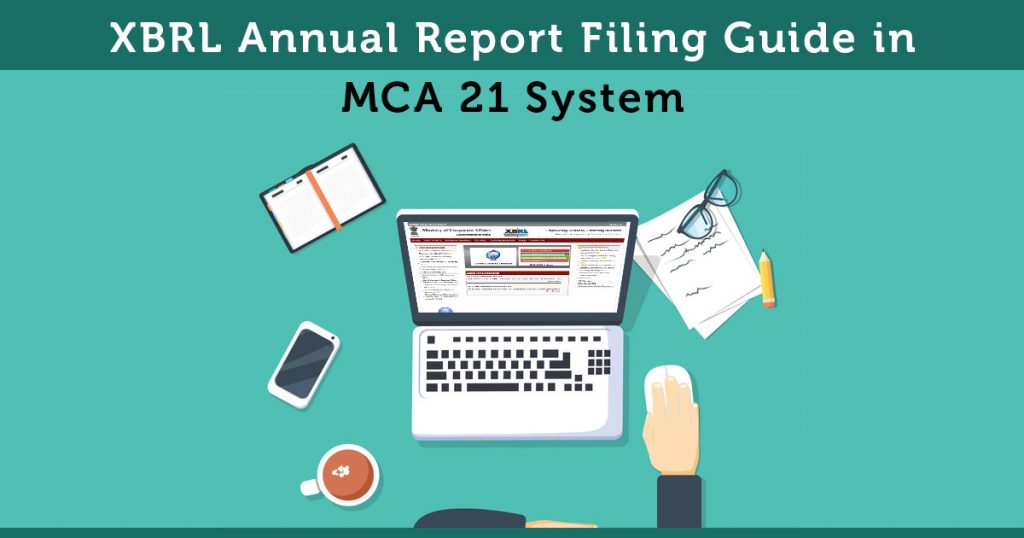
In this article, you will learn the step-by-step process for filing XBRL annual report through the online MCA 21 System at the government portal. Here we will go through all those steps necessary for the filing of the annual report in the MCA 21 system.

  • Step 1: Creation of XBRL instance document
  • Step 2: Download XBRL validation tool from the MCA portal
  • Step 3: Use the tool to validate the instance document
  • Step 4: Perform pre-scrutiny of the validated instance document through the tool
  • Step 5: Attach instance document to the Form 23AC and Form 23ACA
  • Step 6: Submitting the Form 23ACA and Form 23ACA on the MCA portal

Step 1 – Create an XBRL Instance Document

Creation of the XBRL instance document further involves the following three steps:

  • Map company’s each financial statement element to a corresponding element in published taxonomy
  • Create instance document for Balance sheet and Profit and loss Account
  • Review and verify the instance document

A. Map company’s each financial statement element to a corresponding element in published taxonomy: 

Two options are available for the companies to create XBRL documents: In house creation and appointment of the third party for the conversion of the company’s financial statements in XBRL form. In the former option, the XBRL taxonomy elements are tagged under different accounting heads in the company’s books of accounts. Now the mapping of the taxonomy elements with the accounting heads will be done for the conversion of accounting information into XBRL form. (Mapping refers to the process of comparison between the concepts in the financial statements and the elements in the published taxonomy wherein a taxonomy element is assigned to each concept of financial statements.) 

Selection of relevant elements for the elements of financial statement demands considerable knowledge and expertise. The mapping should be properly checked and examined before stepping ahead as the entire reporting is based on the mapping. For tagging or capturing. The details available in brackets in the labels by the company can either be presented as footnotes or the detailed tags, if available. The details available in the financial statements for which corresponding tag/element is not available in the taxonomy can be presented in the next best suitable element in the taxonomy or can be presented under the corresponding ‘Others’ element. It is mandatory to include footnote for the same during the preparation of the instance document.

B. Create instance document for Balance sheet and Profit and loss Account:

Next step is to create the instance document for Balance sheet and Profit and loss account. An instance document refers to an XML file that constitutes business reporting details and financial facts, represented in the form of tags from the XBRL taxonomy. Instance documents need to be created separately for Stand-Alone Balance sheet and  Profit and Loss Account of the company as well as for the Consolidated Balance sheet and Profit and Loss Account of the company and should encompass the financial data for the current and the previous financial year. Few noteworthy points to be kept in mind while creating the instance document :

1. In the instance document, the value of the xlink: href attribute in the schemaRef element must be http://www.mca.gov.in/XBRL/2011/08/27/Taxonomy/CnI/ci/in-gaap-ci-2011-03-31.xsd
2. The design of an XBRL instance document must be valid as per the schemas in the DTS (Discoverable Taxonomy Set)
3.  The value of the scheme attribute of the identity element in the context should be http://www.mca.gov.in/CIN
4. The value of the identity element in the context must all be x-equal and must be the CIN of the company
5. Context  must not contain segment/ scenario element
6. An instance should not have duplicate xbrli: context elements
7. Every xbrli:context element must appear in at least one contextRef attribute in the same instance
8. An instance should not contain more than one fact with the similar element name and equivalent contextRef attributes
9. All monetary figures and facts should have the same unitRef attribute. However, the monetary values for the subsidiary information such as share capital, reserves etc. can be reported in a different currency and so they can have the different unitRef attribute
10. Data analogous to one single concept must not have contextRef attributes relating to contexts with the coinciding time frame periodType=”instant”, depicts the same date
periodType=”duration”,depicts the same duration that coincides
For further understanding, we are presenting some contexts having coinciding/ overlapping duration (which is disallowed).
11. A link:footnoteLink element must have only – link:loc, link:footnote, and link:footnoteArc
12. A link:footnoteLink link:loc xlink:href attribute must mandatory begin with sign “#”
13. Every nonempty link:footnote element should be linked to a minimum of one fact
14. Insignificant digits for numerical facts must have to be =  “0″
15. An instance document must not have unused units
16. When an unescaped content of a fact with base type nonnum: escapedItemType have the “<” character pursued by a QName & whitespace, “/>” or “>”, then the un-escaped content must have only a sequence of text & XML nodes
17. Only the plain text is allowed for the value of a fact. HTML/RTF is disallowed
18. A fact should have a footnote if it contains an id attribute and a link:footnoteArc to a nonempty link:footnote in the same instance
19. Filings must have reference to recognized files at the definitive URI locations. A reference to a local copy is disallowed
20. ContextRef attribute with values x-equal to each other is a must have for the sub-elements in a tuple in an instance
21. The xsi:nil=”true” attribute must be utilised just to convey a value which is different from “zero” as well as from not reporting the fact possibly, or to identify a fact particularised solely by a link:footnote
22. The value of the decimals/precision attribute of a fact must relate to the veracity of the analogous amount as furnished in the financial statements
23. The content of numerical figures must not have scale factor
24. While opting the most relevant element for facts in one or more periods, the element’s xbrli:periodType attribute supersedes the type attribute, which in turn supersedes the element’s documentation string, which in turn supersedes the label string, which again supersedes the link:reference elements
25. Never use units that interprets a scale factor for a currency
26. Text displayed in the financial statements at the page’s bottom or at the table’s bottom followed by a superscript must come out as the text of a link:footnote element in the instance
27. Each unit must pop up with only one scale factor in an instance
28. Every numerical fact like a number of shares should have an associated unit (e.g. xbrli:shares) which must be declared
29. All contexts and units must show up before any item/tuple
30. Name of the XBRL document should be exclusive in the disclosure system
31. Filers must follow only one taxonomy which is prescribed as the standard taxonomy in the disclosure system
32. “UTF8“ is a must encoding of all XBRL documents
33. The xbrli:xbrl element must not contain any facts and figures with the precision attribute
34. The selection of element must be in priority as per the following order,
35.  Period type, data type, documentation, label and reference

HTML Guidelines are as follows:

It should be noted that the XBRL content will be concluded in diversified media kinds (encompassing print media, HTML viewer, small screen digital machines and so on). It is needed that the embedded HTML is well rendered in each one of the media kinds. So, it is important that the HTML contents purse the instructions to ensure that the HTML is used just to classify the content. 

Note: The instructions are applicable to the HTML after decoding the value filled in the XML element in the XBRL instance.

A. All tags should be written in the lowercase case and must be properly closed. 
B. The following predefined CSS classes can be used for displaying.

  • header1 – top-level header
  • header2 – next level header
  • header3 – even next level header
  • header4 – even next level header
  • header5 – bottom level header
  • bordered – tag with visible borders
  • unbordered – tag with invisible borders
  • tableHeader – headers of the table
  • tableRow – row in the table
  • tableRowLabel – the label for a row
  • tableRowValue – A value inside a table
  • normalText – Normal text
  • noteText1 – For writing a note level 1 (top-level) [notes are texts that are important
  • to mention, but does not match exactly with the context of the text (not to be confused
  • with XBRL context). The top-level will be shown as the most important]
  • noteText2 – For writing a note level 2
  • noteText3 – For writing a note level 3
  • noteText4 – For writing a note level 4 (bottom level)
  • numericValue – Used for specifying numeric values
  • nonNumericValue – Used for non-numeric text
  • highlightedText1 – Highlighted text level 1 (top-level)
  • highlightedText2 – Highlighted text level 2
  • highlightedText3 – Highlighted text level 3
  • highlightedText4 – Highlighted text level 4 (bottom level)

Read also: Due Dates of XBRL Filing with MCA 21

C. Stating style attribute for HTML tags is disallowed.
D. Tags like <div> and <span> are used for organizing the content.
E. Diversified classes for the one element can be itemised by separating them with space.
F. Only –  <span>,  <div>, <p>, <br>, <td>,<table>, <tr>, <tfoot>,<thead>, <tbody>, <th>,<colgroup>, <col>, ; are allowed . HTML formatting tags such as <b>, <i> etc. are disallowed.
G. Avert exceeding one level of table nesting.
H. Processing guidelines are disallowed.
I. Only –   & < >  entities are allowed – .  Other entities are disallowed.

36. For Extended role – [610000] General information about financial statements- The details should be presented according to the below-mentioned classification, in the instance documents
37. The companies need to use the standard taxonomy as published by MCA and no extensions are allowed for the first year. So in these cases, companies need to stringently follow the calculation norms of taxonomy and compute the totals and subtotals in accordance with it to avert calculation inconsistencies and errors.
38. When the value or information are adjusted or integrated to match the calculation relationships ( but actually are different from the company’s financial statements), a footnote showcasing the adjustments should be added.
39. The language attribute for the textual information in the instance document is ‘en’.
40. When the last name of the director is unavailable for the DIN details, then it should be mentioned as the dot(.).It should be noted that in such cases, the element for the last name of the director must be added in the instance document.

C. Check and Correct the instance document: After the preparation, make sure that the instance document is correct and all the information is accurately furnished.

Step 2 – Download XBRL Validation Tool from the MCA portal

XBRL validation tool is provided on the MCA portal to validate the generated XBRL instance document which is an ad hoc for filing the balance sheet and P&L account on MCA portal. In addition, this tool provides a facility to access and search the taxonomy. So, the second step is to download the XBRL validation tool from the MCA portal.

Step 3 –  Validate the Instance Document using an XBRL validation tool

While validating the instance document via an XBRL validation tool, ensure the follow Validate the instance document in compliance with the latest and right version of taxonomy as stated by MCA. Enter all mandatory details. Validate everything in accordance with the taxonomy. 

  • Refer Annexure – I  for – ‘How to interpret validation errors’
  • Refer Annexure – II for – ‘List of common errors’

Step 4: Pre-scrutinise the Certified Instance Document

Pre-scrutinise the certified instance document through the same XBRL validation tool. Ensure to have a working internet connection. Perform Server-side certification means to validate the certified instance document through the MCA 21 system. Use an in-built feature “Viewer” of the XBRL validation tool to validate the appearance/presentation of the generated XBRL instance document. Using the “Viewer” feature is mandatory for firms to ensure the correctness of the instance document.

Step 5: Affix the Instance Document with Form 23AC and Form 23ACA​​​​​​​

Form 23AC and Form 23ACA shall be presented individually on the MCA portal for filing in XBRL form. Fill the Form 23 AC and Form 23 ACA. Affix the certified and pre-scrutinised instance document for the Balance sheet to Form 23 AC. Affix the certified and pre-scrutinised instance document for Profit and Loss account to Form 23 ACA. Affix instance documents separately to the combined financial statements in addition to the individual done in above-mentioned steps.

Step 6: Submit Form 23ACA and Form 23ACA on the MCA Portal

After filling the forms, pre-scrutinise them > sign them >  upload them, following the standard e-Form filing procedure. The affixed instance documents shall be well validated and properly examined via XBRL validation tool. Once submitted in XBRL format on MCA portal, the balance sheet and profit and loss submitted along with Form 23AC and 23ACA are available in machine-readable form, so to view and access them MCA 21 system first need to convert these files into the human-readable format and make these documents available for view.

Gen XBRL Software is an outstanding tool for the experts like Company Secretaries and Chartered Accountants who are forced to spend a considerable amount of time on preparation and e–filing of the balance sheet, profit & loss A/c in latest XBRL format in excel. Gen XBRL return filing software empowers you to do above-mentioned responsibilities at very comfort.

Now prepare XML for accounting standard and Indian accounting standard (IND AS) along with XML for both standalone and incorporate financial statement. Our XBRL filing software is up-to-date and user-friendly. It is entirely based on MCA Business Rules and taxonomy. Our software for XBRL validation tool can also complete import and export of XML of the current year or previous year with comfort. The software can develop company-wise back up and restoration and directly validate the XML prepared from any other vendor’s software along with the generation of the PDF file of XML with the validation. Now, a person can classify out all the difficulties related to the annual report in XBRL format.

Tax Benefit on Home Loan Interest & Principle F.Y. 2018-19 (A.Y. 2019-20)

Tax Benefit on Housing Loan

To understand the key tax benefit on a home loan, we are bifurcating the repayment techniques into four major elements- tax benefits on principal repaid, tax benefits on interest paid, deduction on pre-construction interest and section 80EE income tax benefits. The next section will let you know the concept of all in detail.

Tax Benefits on Principal Re-paid

Under section 80C of the Income Tax Act, the maximum deduction allowed for the repayment of the principal amount of home loan is Rs. 1.5 lakh. Deduction under section 80C also includes investments done in the PPF Account,  Equity Oriented Mutual funds, Tax Saving Fixed Deposits, National Savings Certificate, etc. subject to the maximum of Rs. 1.5 lakhs.

Besides this, there are stamp duty and registration charges that one can claim under the aforementioned section. Though, the claim can only take place in the year in which the payment has been made.

Nevertheless, there’s a condition under which this repayment of the principal amount of housing loan is allowed. The deduction is only possible after the house gets entirely completed and there is a completion certificate for the same. Principal amount paid on any under construction structure/property is not going to be a part of this section.

Tax Benefits on Interest Paid

Under section 24 of the Income Tax Act, one can avail the deduction on Home Loan for payment of Interest tax benefit. The self-occupied property allows the deduction with the maximum limit of Rs. 2 lakh if it takes the completion within 5 years from the end of the Financial Year, otherwise the maximum limit is Rs. 30,000.

Interest on housing loan paid for let out property is fully allowed in the relevant assessment year in which it is claimed.

From Assessment year 2018-19, the loss from house property head that will be allowed to be set off from other heads of income will be restricted to Rs 2,00,000 in particular assessment year and the rest amount shall be carried forward for set-off in subsequent years.

Read Also: Tips to Save Income Tax in India

Deduction on Pre-construction Interest

You can also claim interest on housing loan paid before completion of construction of the property. It is termed as pre-construction interest. It is allowed in 5 equal installments beginning from the financial year in which the construction is completed. The limit of 2 lacs will also apply for pre-construction interest in case of self-occupied property. However it is fully allowed in case let our property.

Section 80EE Income Tax Benefit

Section 80EE proposes an additional deduction of Rs.50000 in respect of interest on housing loan to the first time house owners who own the house of Rs.50 lakh or less and has taken the home loan amount of less than or equal to Rs.35 lakh. The loan should be sanctioned between April 1, 2016, and March 31, 2017 to claim deduction under this section. This deduction allowed shall be in addition to the interest allowed under section 24(b) of the Income Tax Act, 1961.

Discord Between Banks & Govt. Over INR 18,000 Crore IGST

GST

Financial institutions have been fending off the service taxes and GST notices since April 2018 and this has again led to a dysfunctional relationship between banks and Government of India.

The Government has levied Rs 18,000 crore goods and services tax (GST) on banks for their services like wealth management, zero-fee lockers, ATM facilities etc. Financial institutions have scuffled with the government and went to court over this matter. An animosity between banks and government has become the run of the mill and the government is dealing with this matter since 2015.

According to some sources, the tax notices related to service tax and GST have been sidestepped by the private, public and foreign banks since April 2018, as they prefer to present representations at different forums before stepping ahead towards the Delhi High Court regarding the notices.
The Delhi High Court has asked banks to respond to the government notices regarding the dues of Rs 18,000 crore GST applicable to bank services including lockers with zero annual rent, deposits and wealth management. August-end has been set as the deadline to answer the notices, by the Delhi HC.

The government is accusing public banks of deceiving the taxes to upkeep the Monthly Average Balance (MAB). For instance, Banks catered locker facility to the customer in exchange for a deposit worth Rs 50,000, rather than at a yearly rent of Rs 20,000 for a locker facility because of applicability of Rs 360 GST on the rent while deposits do not germinate any liability towards the government revenue.

At the same time, Foreign and private banks provided free facilities including free ATM and debit card along with other offers and wealth management service to the “premium account holders” which has abbreviated their contribution in the government treasury.

Read Also: Know GST Charges for Cheque Bounce by Banks 

However, according to the bankers, these practices were a part of the normal course of practices and were not initiated with an intent to avert the tax obligation

Haryana Contributes A Good Sum To The National GST Collection

Haryana has created a benchmark by contributing the highest of 4.7 percent in the national GST collection. It is one of the 29 states in India owning just 1.8 percent of the geographical land of the country and accommodating the 2.9 percent of the national population.

State’s finance and tax minister Captain Abhimanyu declared that the per capita GST collection of the state holds Rs. 21,745 which is more than twice the national per capita GST Collection (Rs 9,370).

Collections under GST are further segregated into four different Acts namely, Haryana Goods and Services Tax Act, 2017, Central Goods and Services Tax Act, 2017, Integrated Goods and Services Tax Act, 2017, and the Compensation to States Tax Act, 2017.

The minister said, Haryana has the highest GST return filing compliances in the country. He further clarified his words by addressing some statistics, the yearly collection of the state including all the four Acts was Rs. 55,231 crore which if calculated on a monthly basis is Rs. 4,602.56 crore per month. The State GST collection of Haryana in the financial year 2018-19 is Rs 18,987.83 crore against the collection of Rs. 10,844.6 crore in the financial year 2017-18 which clearly shows that the state has shown the growth of 16.77 percent in regards to GST Collection.

Abhimanyu says on a good note, the return compliance of the state alone is 4.5 percent higher than the average national return compliance making it one among the top three high GST compliant states in the country.

The state government keeps a check on the non-fillers. They regularly send SMS alerts, emails and show-cause notices to the non-fillers.

The minister further stated that the taxation department is working on the refund applications and issuing the refunds to the taxpayers within the time limit of 60 Days. Till date, the department has processed around 10,300 applications granting refunds of Rs. 1643 crores under all the GST Acts.

He said the department has already taken initiatives for increasing the tax revenue and removing the chances of tax-evasion from the state. One among such initiatives is to bring the taxpayers under tax net who were immune from paying tax under VAT, for example, dealers of textiles and pesticides.
Since GST is implemented in the country, from Haryana alone 2,47,814 new taxpayers have been added in the list. Now the total registered taxpayers prevailing in the state are 4,49,827.

Important Steps for Beginners to Filing Income Tax Return

Important Steps for Beginners' Filing Income Tax Return

There are some basic points which should be always kept in mind while filing an income tax return for the first time. As it is a tedious task and has to do with governmental procedures, so for the sake of economy and your own liabilities towards the nation, it is the duty of every citizen or taxpayer to check the rules thoroughly and take notes of these helpful points. So, let’s go through all the important provisions considered under the income tax filing.

The current year income tax filing the due date is 31st July 2019 (now extended to 31st August, 2019 by order of CBDT on 23rd July, 2019) and the mistakes while filing income tax can be reverted to a true position by the revision later. Losses from business and profession, capital gains can be carried forward only when the return is filed on or before 31st August 2018.

Note: Note: For AY 2019-20, the due date is 31st August 2018. After that penalty, u/s 234F will be levied. Under Section 234F, an individual would have to pay a penalty of up to Rs 10,000 for late filing income tax return after the due dates. A penalty of Rs.5000 will be applicable for returns filed after the due date of 31st August but before 31st December of the relevant assessment year. The return filed after December will attract a penalty of Rs.10,000. For assesses with a taxable income of up to Rs.500,000, a reduced penalty of Rs.1000 will be applicable.

One of the most important steps to be taken while filing for income tax is that one must link their Aadhar Number while filing an income tax return and when one is applying for a new Permanent Account Number. Also one must note down the consequences that if the taxpayer fails to link PAN cards to the Aadhar numbers before the deadline of June, the application will be discarded straight away.

One should know the time period for which the income tax return is filed up i.e. from April 1 to March 31, which is a standard time period followed in almost every financial year.

The tax slab has to do with the income tax computation as there are various slabs to be careful with different categories of income.

Income Tax Slab Rates for The F.Y. 2018-19 (A.Y. 2019-20)-(FOR INDIVIDUAL)

IncomeGeneral RatesSenior Citizens (60<=Age < 80)Super Senior Citizen (80<=Age)
Up to Rs. 2,50,000NILNILNIL
Rs. 2,50,000 to Rs. 3,00,0005%NILNIL
Rs. 3,00,000 to Rs. 5,00,0005%5%NIL
Rs. 5,00,000 to Rs. 10,00,00020%20%20%
Above Rs. 10,00,00030%30%30%

The basic exemption limit is Rs 300,000 and Rs 500,000 for individuals aged 60/80 and above respectively. Health & Education cess of 4% will be levied on the amount of income-tax plus surcharge. The surcharge is levied @10% where total income exceeds Rs.50 lakhs up to Rs. 1 crore. A surcharge of 15% is applicable when the total income exceeds Rs. 1 crore.

Income Tax Slab Rates for The F.Y. 2018-19 (A.Y. 2019-20)-(FOR INDIVIDUAL)

IncomeGeneral RatesSenior Citizens (60<=Age < 80)Super Senior Citizen (80<=Age)
Up to Rs. 2,50,000NILNILNIL
Rs. 2,50,000 to Rs. 3,00,0005%NILNIL
Rs. 3,00,000 to Rs. 5,00,0005%5%NIL
Rs. 5,00,000 to Rs. 10,00,00020%20%20%
Above Rs. 10,00,00030%30%30%

Surcharge On Income Tax

  • a. Total income exceeding Rs. 50,00,000 but not exceeding Rs. 1,00,00,000, at the rate of 10%, of income tax
  • b. Having a total income exceeding Rs. 1,00,00,000 at the rate of 15% of income tax

Some basic identity details like address, contact number, email id, bank account details along with IFSC code and PAN i.e. permanent account number which is very much necessary for any tax process in India.

Health and education cess at the rate of 4% of the tax amount are levied.

Various source of income should be mentioned in the filing of return which can determine the tax computation accordingly, some of the common taxable income categories are:

  • Income from salary
  • Income from house property
  • Income from capital gains
  • Income from business and profession
  • Income from other sources

Form 16 and 12BA is a salary based tax computation documents which the employer of person seeks the authority to withhold on your salary.

A consolidated document of TDS, TCS, Advance tax etc. can be gained from Income tax departments website named as Form 26AS in which all the paid taxes are shown.

Also, the investment proof required to be given while claiming for the refund or exemption in interest which marks up to Rs 2,00,000. in case of self-occupied property. Investments/Contributions made under LIC, PPF, NSC, ULIPS also comes under exemption scheme under section 80C up to the limit of Rs 150,000. This also includes the contribution of the EPF while in employment.

After all this process, there comes a point where the proper income tax return form is to be identified. Generally, there are some forms which are classified in various cases like:

  • a. ITR1 – Applicable to an individual having income from salary/one house property (not a case of brought forward loss) / other sources (not being lottery winnings and income from race horses) and (having income up to Rs.50 lakhs).
  • b. ITR2 – Applicable to Individuals/Hindu Undivided Family (HUF) not having income from business or profession
  • c. ITR3 -Applicable to an individual/ HUF having income from Business and Profession.

Finally, the verification part is left. Earlier returns were e-verified after submitting the XML. But now the verification part has to be done prior to uploading XML. Either we can verify our return online by the process of e-verification through Aadhaar or we can send the signed copy of ITR to the Centralized Processing Centre (CPC) of the Income Tax Department by any means of the post within the time frame of 120 days failing which the person has to again re-file the return.

Some of the general topics are discussed just above for the sake of hassle free return for the first time income tax filers.


Explained: Calculation of Income Tax For Assessment Year 2020-21

Calculation Income Tax AY 2020-21

Union budget which was recently unveiled on 1st Feb 2019 took turns for many reasons for both positive and negative aspects of the common public. The announcement of union budget has struck through various benefits for the farmers including yearly INR 6000 pay for the lesser than 2 hectares of the land of any individual farmer. While income tax rebate took the central position of the announcement.

The announcement of union budget 2019, there were multiple benefits showered on the middle class as well as on the farmers alike. The salaried one also got some relief as the government has given full tax rebate up to an income of 5 lakhs.

The effects will take place after the onset of the Assessment Year 2020-21 which will further implement the changes done on an actual level.

Also, note some of the significant changes in the income tax laws:

  • Full tax rebate on income up to INR 5 lakh while in other cases all the aspects i.e. income tax rates/slabs will remain unchanged
  • Standard deduction limit which is applicable to the employees and pensioners hiked from INR 40,000 t0 INR 50,000

Now, Here we will go through some examples understanding the latest amendments in the income tax slab which will further change the liability aspect of a taxpayer.

Tax Calculation According to the Budget 2019
Taxable Annual Income (After Adjusting Deductions)INR 3,50,000INR 4,00,000INR 5,00,000INR 10,00,000
TaxINR 5,000 (@ 5% on 1,00,000)INR 7,500 (@ 5% on 1,50,000)INR 12,500 (@ 5% on 2,50,000)INR 1,12,500 (@5% on 2,50,000, 20% on 5,00,000)
Rebate under Section 87A of I-T ActINR 5,000INR 7,500INR 12,500NA
Tax liability000INR 1,12,500
Cess @ 4%000INR 4,500
Tax payable (after cess)000INR 1,17,000
Tax Calculation According to the Budget 2018
Taxable IncomeINR 3,50,000INR 4,00,000INR 5,00,000INR 10,00,000
TaxINR 5,000INR 7,500INR 12,500INR 1,12,500
RebateINR 2,500NANANA
Balance TaxINR 2,500INR 7,500INR 12,500INR 1,12,500
CessINR 100INR 300INR 500INR 4,500
Tax payableINR 2,600INR 7,800INR 13,000INR 1,17,000

Read Also: Revisit History of IT Slabs (1944-45 to 2018-19) in India Since Independence

CBDT to Launch Country-wide Taxpayer e-assistance Campaign on 159th Income Tax Day on July 24

Income Tax Day

On 24th July, the CBDT will conduct a taxpayer e-assistance campaign across the country to acknowledge the 159th Income Tax Day. while the Finance Minister Nirmala Sitharaman will be the chief guest of the event, as mentioned from the Officials. The Central Board of Direct Taxes (CBDT) is authorized body behind the launch of the campaign and all the regional offices of the Income Tax Department will be benefited with this movement, they further added.

The taxman that is authorized to maintain camps across the country, will help taxpayers in e-filing of their tax returns and this “hand-holding” program will make taxpayers aware with recently made changes to the forms, laws and utilities (software) of the direct taxes system, PTI reported as per a policy plan.

The CBDT, responsible to craft policy for the department, planned for the campaign post getting representations from taxpayer and stakeholders, likewise chartered accountants and bank, that they require more help in terms of filing returns electronically and performing several other IT related duties under the tax laws, they said.

On 24th July, all the regional offices of the Income Tax Department will commemorate the day by honouring the taxpayers who file their taxes diligently. As the sources revealed, the main event will be organized in Delhi and the Finance Minister Nirmala Sitharaman along with the Minister of State for Finance Anurag Thakur will mark their presence as the chief guest.

Not even this, it is being expected that the Union Minister will deliver a speech and the top officials of the department like Indian Revenue Service (IRS) and other officials are likely to be rewarded for their excellent performance in the service.

The event which is going to be held at Ambedkar International Centre on Janpath Road from 10 AM, mandates all officers from the rank of Assistant Commissioner and above posted in Delhi to attend the event, a source said. In the year 1860, the income tax was first levied on July 24, that’s why this day is celebrated as the ‘Income Tax Day’ every year.